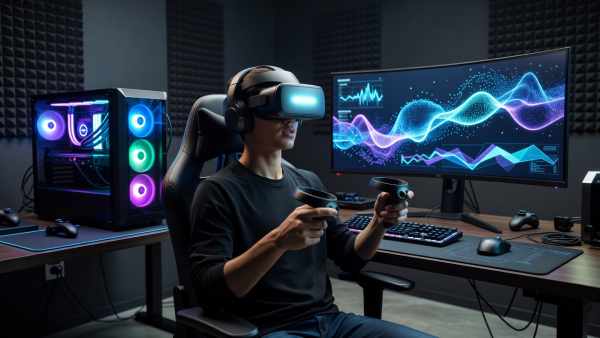
Reducing motion-to-photon latency below the human perception threshold of 10 milliseconds has long been the holy grail of virtual reality hardware design. Through eye-tracking integrated variable rate shading (VRS) and fast wireless compression pipelines, recent lab tests confirm significant breakthroughs.
Eye-Tracking & Variable Rate Shading (VRS)
By tracking user gaze direction at 120Hz, rendering engines concentrate full native resolution shading only on the central fovea region of the human eye. Peripheral regions are shaded at reduced sample densities (1/4x or 1/16x), reducing GPU shading load by up to 60%.
• Total Motion-To-Photon Latency: 9.4 ms average.
• Eye-Tracker Sample Delay: 1.2 ms.
• Shading Workload Reduction: 58% lower GPU compute requirement at dual 4K panel resolution.
Implications for Standalone & Cloud Streaming VR
These architectural improvements allow high-fidelity, photorealistic lighting environments to run on lower-power mobile SoCs and wireless streaming setups without triggering simulator motion sickness.