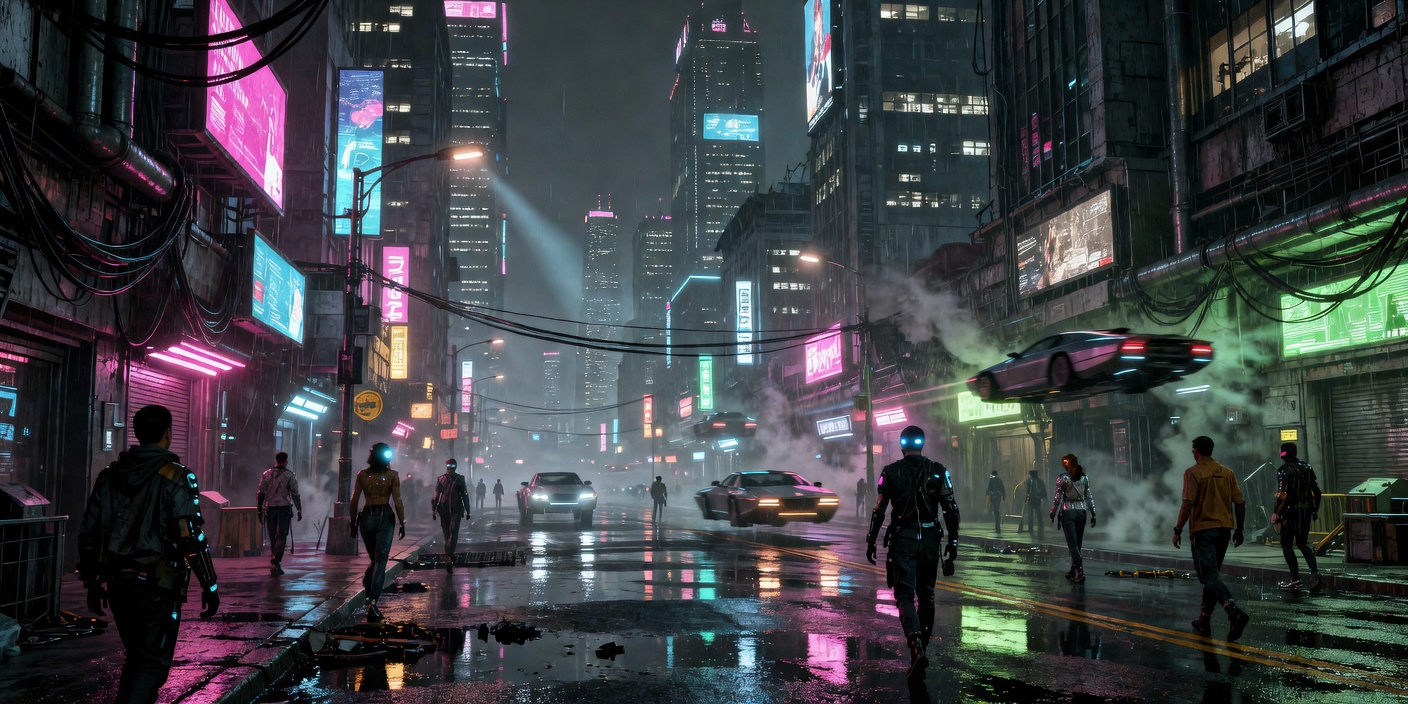
When CD Projekt Red announced its strategic shift toward Unreal Engine 5 for future titles, it marked the conclusion of REDengine's long evolution. However, the final iteration deployed in Night City represents one of the most technologically ambitious graphics milestones in PC gaming history.
The Challenge of Full Path Tracing in Dynamic Open Worlds
Unlike traditional rasterization techniques that rely on screen-space reflections, ambient occlusion approximation, and baked lightmaps, REDengine’s path tracing mode calculates physically accurate light bounces across geometric surfaces in real time.
• Ray Bounces: 2 full bounces per pixel with neural denoiser.
• Shader Execution Reordering (SER): Up to 32% efficiency boost on Ada Lovelace architecture.
• Memory Allocation: 14.2 GB VRAM buffer required at 3840x2160 native resolution.
Neural Denoising and Ray Reconstruction Integration
The introduction of AI-driven Ray Reconstruction solved a historical bottleneck in realtime graphics: noisy temporal accumulation. By replacing hand-tuned denoisers with a trained neural network, the engine retains sub-pixel specular details, such as light scattering through rain puddles and neon signage refractions, without smearing artifacts.
As industry studios adopt unified engine frameworks, REDengine's legacy remains a masterclass in custom engine specialization, demonstrating what can be achieved when rendering software is tailored specifically for a single, dense open-world environment.